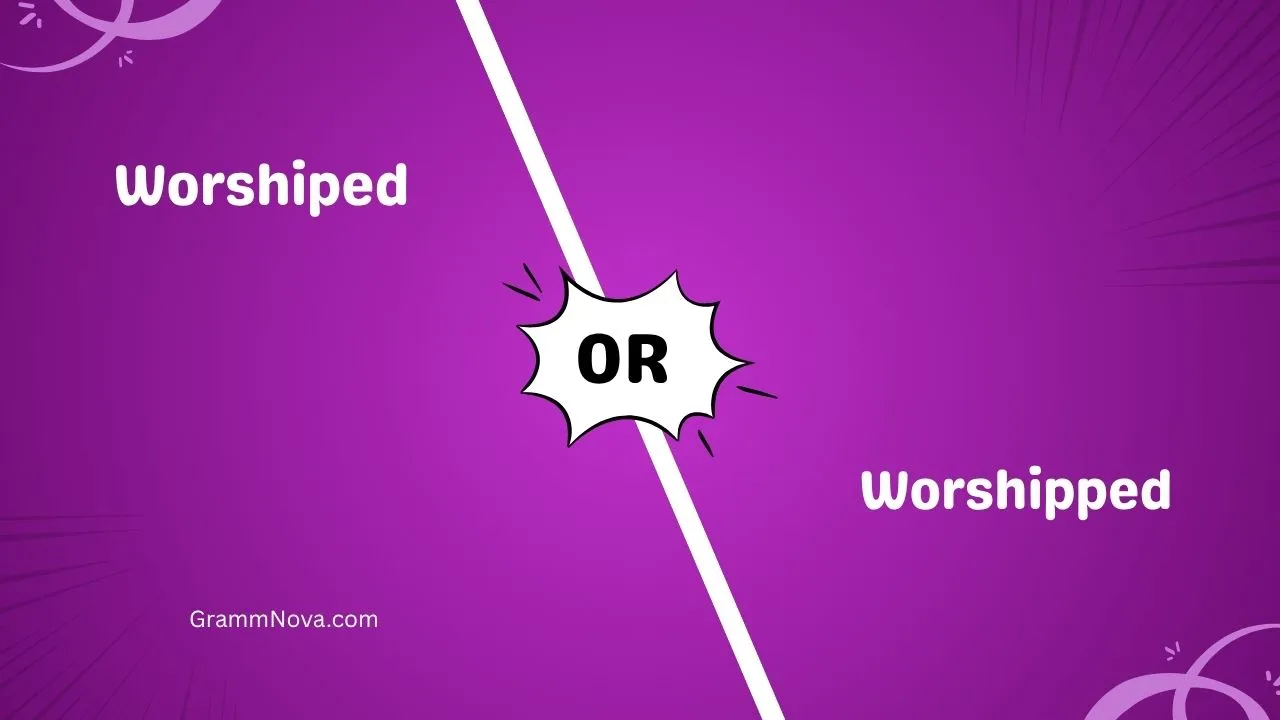
When you come across the words Worshiped or Worshipped, you might wonder which spelling is correct and when to use each one. This small spelling difference often creates confusion among writers, students, and English learners around the world.
Both forms look similar, sound the same, and share the same meaning, but their usage depends on the variety of English you follow.
Understanding the difference can help you write more accurately and confidently in academic, professional, and everyday communication.
Quick Answer (Simple Summary)
Both “worshiped” and “worshipped” are correct. “Worshiped” is American English, while “worshipped” is British English.
Meaning of “Worship” in English Grammar
Before comparing spellings, it’s important to understand the base word.
What Does “Worship” Mean? 🙏
The word worship means:
- To show deep respect or love for a god
- To admire someone greatly
- To honor something or someone strongly
Simple Explanation
👉 It refers to deep reverence, devotion, or admiration.
What Does “Worshiped” Mean?
The word worshiped is the American English past tense of worship.
Meaning
It means:
👉 To have shown respect, devotion, or religious honor in the past.
Examples of “Worshiped” ✍️
- The ancient league worshiped the sun.
- She worshiped her ancestors in a traditional ceremony.
- People worshiped idols in old civilizations.
- He worshiped the idea of success.
- They worshiped together every Sunday.
👉 In American English, this spelling is preferred in writing, schools, and newspapers.
What Does “Worshipped” Mean?
The word worshipped is the British English past tense of worship.
Meaning
👉 Same meaning as “worshiped,” just different spelling.
Examples of “Worshipped” ✍️
- The villagers worshipped their god at the temple.
- She worshipped her family traditions deeply.
- They worshipped in silence during the ceremony.
- Ancient Romans worshipped many gods.
- He worshipped nature and its beauty.
👉 This spelling is commonly used in the UK, Australia, and other British English regions.
Worshiped vs Worshipped: Key Differences Table 📊
| Feature | Worshiped | Worshipped |
| English Type | American English 🇺🇸 | British English 🇬🇧 |
| Spelling Rule | One “p” | Double “p” |
| Meaning | Same | Same |
| Usage | USA, Canada | UK, Australia, India (British style) |
| Formal Writing | Accepted | Accepted |
| Example | They worshiped the god. | They worshipped the god. |
👉 Important: Meaning never changes—only spelling does.
Why Two Spellings Exist in English? 🤓
English has evolved differently across regions.
Key Reasons:
- Noah Webster simplified American spelling
- British English kept traditional forms
- Regional language evolution over time
- Differences in pronunciation influence spelling
👉 That’s why we see pairs like:
- traveled / travelled
- canceled / cancelled
- worshiped / worshipped
Grammar Rule: Which One Should You Use?
Here’s the simple rule:
Use “Worshiped” when:
- Writing for American audiences 🇺🇸
- Following US English guidelines
- Publishing in US-based content
Use “Worshipped” when:
- Writing for British audiences 🇬🇧
- Following UK English standards
- Academic writing in Commonwealth countries
👉 If you are unsure, pick one style and stay consistent.
Common Mistakes with Worshiped/Worshipped ❌
Many learners make small but important mistakes.
Mistake 1: Mixing both spellings in one article
✔ Correct: Stick to one style only
Mistake 2: Thinking one is incorrect
✔ Reality: Both are correct depending on region
Mistake 3: Confusing pronunciation
✔ Tip: Both are pronounced the same way
Memory Trick to Remember the Difference 🧠
Here’s a simple trick:
👉 “Double P = British People Prefer It”
- Worshippped → UK 🇬🇧
- Worshiped → US 🇺🇸
Another easy one:
👉 “Extra letter = Extra British tradition”
Real-Life Usage Examples 🌍
Email Example 📧
We worshiped at the shrine during our visit. (US style)
We worshipped at the shrine during our visit. (UK style)
Social Media Example 💬
People worshiped the singer like a superstar 😍
News Writing 🗞️
The community worshipped together during the festival ceremony.
Academic Writing 🎓
Ancient civilizations worshiped natural elements such as fire and water.
Everyday Speech 🗣️
They worshipped at the temple every weekend.
British vs American English Trends 🇬🇧🇺🇸
American English Trends:
- Simplified spelling (one “p”)
- Used in global tech and business content
- Common in online platforms
British English Trends:
- Traditional spelling preserved
- Used in academic UK writing
- Preferred in Commonwealth countries
👉 Both are correct, but consistency matters more than choice.
Related Grammar Keywords 🔍
This topic connects with many SEO-related search terms:
- worshiped or worshipped difference
- correct spelling worshiped worshipped
- British vs American English spelling
- past tense of worship
- common English spelling mistakes
- grammar tips for beginners
- English usage rules
- spelling variations in English
FAQs: Worshiped vs Worshipped ❓
1. Is worshiped correct spelling?
Yes, it is correct in American English.
2. Is worshipped wrong?
No, it is correct in British English.
3. Why are there two spellings?
Because American and British English evolved differently.
4. Do worshiped and worshipped have different meanings?
No, both mean the same thing.
5. Which spelling should I use in exams?
Use the version based on your curriculum (US or UK English).
6. Is worshiped more modern?
It is simply simplified American spelling, not newer meaning.
7. Can I mix both spellings?
No, always stay consistent in one writing style.
Conclusion:
In conclusion, both Worshiped and Worshipped are correct spellings, but their usage depends on the variety of English you follow. Worshiped is more common in American English, while Worshipped is preferred in British English and other regions that follow British spelling rules.
Understanding this difference helps you write more accurately and communicate clearly. Whether you choose one spelling or the other, the meaning remains the same: to show deep respect, honor, or devotion. By knowing these small spelling variations, you can improve your grammar skills and use English more confidently in everyday writing.

I am David Wilson, a passionate English grammar writer dedicated to making language learning simple and easy to understand. I am focused on helping readers improve their grammar, vocabulary, and writing skills with clear and practical explanations. I am committed to creating helpful content that removes confusion from commonly mistaken English rules.