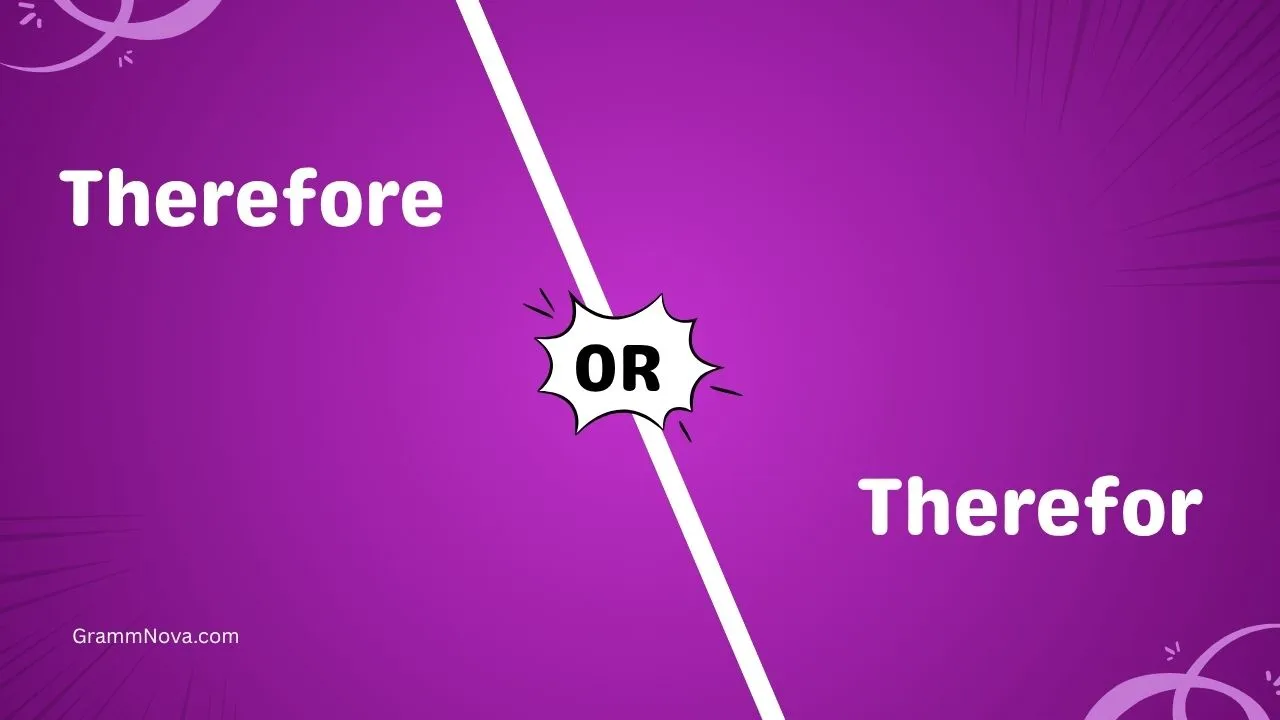
Have you ever paused while writing and wondered whether “therefore” or “therefor” is the correct word? You’re not alone! These two words look almost identical, but they have completely different meanings and uses.
Choosing the wrong one can make your sentence confusing or even change its intended meaning.
Therefore is a common word used in everyday and academic English to show a result, conclusion, or logical connection, while therefor is a much less common legal or formal term meaning “for that” or “for it.
Quick Answer ✅
Therefore means “for that reason” or “as a result.” It is commonly used in everyday, academic, and professional English.
Therefor means “for that” and appears mainly in legal, formal, or old-fashioned writing. In modern English, you’ll rarely need to use it.
Therefore vs Therefor at a Glance
| Word | Meaning | Part of Speech | Common Usage | Example |
| Therefore | As a result; for that reason | Conjunctive adverb | Very common | She studied hard; therefore, she passed. |
| Therefor | For that; in exchange for that | Adverb | Rare; legal/formal | Payment therefor shall be made within 30 days. |
What Does “Therefore” Mean?
Therefore means “for that reason,” “because of that,” or “as a result.”
It connects two ideas by showing that one event is the result of another. It’s one of the most common linking words in English grammar.
When Should You Use “Therefore”?
Use therefore when:
- One event causes another
- You’re explaining a conclusion
- You’re writing essays
- You’re writing emails
- You’re making logical arguments
- You’re presenting evidence
Formula
Reason + Therefore + Result
Example:
It was raining heavily. Therefore, we stayed indoors.
Examples of “Therefore”
Here are plenty of examples to help you master the word.
Everyday Conversation
- I forgot my wallet; therefore, I couldn’t pay.
- She was tired; therefore, she went to bed early.
- The bus was late. Therefore, I missed my meeting.
- He exercised regularly; therefore, he stayed healthy.
- We arrived early; therefore, we found good seats.
Academic Writing
- The sample size was too small; therefore, the findings cannot be generalized.
- Water expands when frozen; therefore, pipes may burst during winter.
- The experiment failed; therefore, researchers repeated it.
- Demand increased significantly; therefore, prices rose.
Business Emails
- Your application meets all requirements; therefore, we are pleased to offer you the position.
- Payment has not been received; therefore, your order remains on hold.
- The project was completed early; therefore, the client approved the final payment.
Social Media Examples
- I skipped breakfast; therefore I’m starving. 😂
- Coffee first, therefore productivity. ☕
- Weekend is here; therefore happiness begins!
What Does “Therefor” Mean?
Unlike therefore, therefor means:
- For that
- In exchange for that
- For that purpose
It is mostly found in:
- Legal contracts
- Government documents
- Historical texts
- Formal agreements
In everyday English, people almost never use it.
Examples of “Therefor”
Legal Documents
- The buyer shall pay therefor within thirty days.
- Compensation therefor shall be determined by the court.
- The company accepted responsibility and provided payment therefor.
Formal Writing
- A permit and the fee therefor must be submitted together.
- Taxes therefor shall be collected annually.
- Approval therefor was granted by the committee.
Why Is “Therefor” So Rare?
Modern English prefers clearer phrases like:
- for it
- for that
- for this
- in return
- in exchange
Instead of writing:
Payment therefor is required.
Most writers now say:
Payment for it is required.
or
Payment for that is required.
This sounds much more natural.
Therefore vs Therefor: Detailed Comparison
| Feature | Therefore | Therefor |
| Meaning | As a result | For that |
| Frequency | Extremely common | Very rare |
| Everyday English | Yes | No |
| Academic Writing | Yes | Rarely |
| Business Writing | Yes | Occasionally |
| Legal Documents | Sometimes | Frequently |
| Shows Cause and Effect | Yes | No |
| Modern English | Yes | Mostly outdated |
Easy Memory Trick 🧠
Here’s a simple trick you’ll remember forever.
Remember “Therefore”
Think of:
Therefore = Result
If you can replace the word with:
- As a result
- So
- Consequently
- Hence
then therefore is correct.
Example:
It snowed heavily.
↓
As a result…
↓
Therefore.
Remember “Therefor”
Notice the ending:
There + for
It literally means:
For that
If you can replace it with for that or for it, then therefor is correct.
Common Mistakes People Make
Mistake #1
❌ I forgot my password; therefor I couldn’t log in.
✅ I forgot my password; therefore I couldn’t log in.
Mistake #2
❌ The results were excellent therefor we celebrated.
✅ The results were excellent; therefore, we celebrated.
Mistake #3
❌ The customer made payment therefore.
✅ The customer made payment therefor.
(Only in legal writing.)
Mistake #4
Using therefor in everyday conversation.
❌ I’m hungry therefor I’m eating pizza.
✅ I’m hungry; therefore, I’m eating pizza.
Grammar Tips for Using “Therefore”
Remember these grammar rules.
Use a Semicolon
Correct:
She practiced every day; therefore, she improved quickly.
Start a Sentence
Also correct:
Therefore, we decided to leave.
Use After a Period
Correct:
The road was closed. Therefore, we took another route.
Synonyms of “Therefore”
Depending on the context, you can replace therefore with:
- Consequently
- Thus
- Hence
- As a result
- Accordingly
- For this reason
- Because of this
- So
Example
She studied hard.
Therefore, she passed.
OR
Consequently, she passed.
OR
As a result, she passed.
Synonyms of “Therefor”
Since therefor means “for that,” possible alternatives include:
- For that
- For it
- In exchange
- In return
- On that account
These alternatives sound much more natural in modern English.
Real-Life Examples
Email Example 📧
Dear Sarah,
The required documents have been received. Therefore, your application is now complete.
Kind regards,
David
Workplace Example 💼
Sales increased by 20% this quarter. Therefore, the company plans to hire additional staff.
Academic Example 🎓
The hypothesis was supported by the collected data. Therefore, further testing was unnecessary.
Legal Example ⚖️
The applicant shall submit the required fee therefor before approval.
News Example 📰
Heavy rainfall caused severe flooding; therefore, schools remained closed.
Social Media Example 📱
Friday is here. Therefore, pizza night! 🍕
British vs American English
Good news!
There is no spelling difference between British English and American English for these words.
| British English | American English |
| Therefore | Therefore |
| Therefor | Therefor |
The only difference is frequency.
Both countries use therefore regularly.
Both rarely use therefor, except in legal writing.
Tips to Never Confuse Them Again
✅ Ask yourself:
“Do I mean as a result?”
If yes → Therefore
Ask yourself:
“Do I mean for that?”
If yes → Therefor
Remember:
- Therefore = Result
- Therefor = For that
Practice Quiz 🎯
Choose the correct answer.
1.
She forgot her umbrella; ________, she got wet.
✅ Therefore
2.
Payment ________ must be received immediately.
✅ Therefor
3.
The evidence was convincing. ________, the jury agreed.
✅ Therefore
4.
The buyer shall provide compensation ________.
✅ Therefor
5.
It was extremely cold; ________, the lake froze.
✅ Therefore
Frequently Asked Questions (FAQs)
Is therefore or therefor more common?
Therefore is far more common. You’ll see it in everyday conversations, emails, essays, reports, and books. Therefor is mostly limited to legal and highly formal writing.
What does therefor mean?
Therefor means “for that” or “in exchange for that.” It is an old-fashioned word that mainly appears in legal documents.
Can I use therefor instead of therefore?
No. These words are not interchangeable because they have different meanings.
Is therefor outdated?
Not completely. It is still used in legal writing, contracts, and some official documents. However, it is rare in everyday English.
Is therefore a conjunction?
Not exactly. Therefore is a conjunctive adverb, which connects ideas by showing a logical result.
Should I always put a comma after therefore?
Usually, yes. When therefore introduces a clause or starts a sentence, a comma improves clarity.
Example:
Therefore, we canceled the event.
How can I remember the difference?
Think:
- Therefore = Result
- Therefor = For that
This simple memory trick helps most learners avoid confusion.
Final Thoughts
Although therefore and therefor differ by only one letter, they serve completely different purposes. Therefore is a common conjunctive adverb that means “as a result” and is widely used in conversations, essays, emails, business communication, and academic writing. Therefor, on the other hand, means “for that” and is largely confined to legal or highly formal documents.
When you’re unsure, ask yourself what you’re trying to say. If you’re expressing a result or conclusion, therefore is almost always the correct choice. If you’re referring to something for that purpose or in exchange for that, and you’re writing in a legal context, therefor may be appropriate. With these simple rules and memory tricks, you’ll confidently choose the right word every time.

I am David Wilson, a passionate English grammar writer dedicated to making language learning simple and easy to understand. I am focused on helping readers improve their grammar, vocabulary, and writing skills with clear and practical explanations. I am committed to creating helpful content that removes confusion from commonly mistaken English rules.