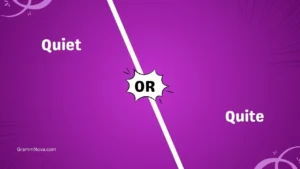
When you write in English, even a single misplaced letter can completely change the meaning of your sentence. That is exactly what happens with quiet and quite. These two words look almost identical, but they have very different meanings and uses.
Many students, writers, and even native English speakers mix them up because the spelling is so similar. If you have ever wondered which one is correct, you are not alone. The good news is that learning the difference is much easier than it seems.
Once you understand how each word works and see a few practical examples, you will be able to use them with confidence in everyday conversations, emails, school assignments, and professional writing.
Quick Answer
“Quiet” means silent or not noisy, while “quite” means completely, very, or fairly depending on context. They are not interchangeable.
Meaning of “Quiet”
The word quiet is mainly used as an adjective meaning silent, calm, or not making noise 🤫
It can also be used as a noun or verb in some contexts.
Simple Meaning
- No noise 🔇
- Calm environment
- Soft or low sound
- Peaceful situation
Example Sentences for “Quiet”
- The library is very quiet.
- Please be quiet during the exam.
- The baby finally became quiet.
- It was a quiet night in the village.
- She prefers a quiet place to study.
Meaning of “Quite”
The word quite is an adverb used to modify adjectives and verbs. It usually means:
- Very
- Completely
- Fairly (in British English sometimes)
Simple Meaning
- To a large degree
- Fully or completely
- Moderately (depending on region)
Example Sentences for “Quite”
- It is quite hot today ☀️
- She is quite happy with her results.
- The movie was quite interesting.
- He is quite tall for his age.
- I’m quite sure about my answer.
Key Difference Between Quiet and Quite
Although they differ by only one letter, their meanings are very different.
Simple Explanation
- Quiet → No sound or silence
- Quite → Degree or intensity (very/fairly)
Comparison Table: Quiet vs Quite
| Feature | Quiet | Quite |
| Word Type | Adjective | Adverb |
| Meaning | Silent, calm | Very, completely, fairly |
| Usage | Describes noise level | Describes intensity |
| Sound | /ˈkwaɪ.ət/ | /kwaɪt/ |
| Example | The room is quiet | It is quite cold |
| Confusion Risk | High | High |
Why Do People Confuse Quiet and Quite?
1. Similar Spelling
They differ by only one letter.
2. Fast Speech Confusion 🗣️
In spoken English, the pronunciation becomes similar.
3. Context Overlap
Both appear in everyday sentences, making them easy to mix up.
Memory Trick to Remember 🧠
Here’s a simple trick:
✔ QUIET = “I” = Inner silence
- Think: quiet = silence inside
✔ QUITE = “E” = Extra emphasis
- Think: quite = extra degree (very)
Another simple idea:
- Quiet = sound (think library 🤫)
- Quite = quantity/degree (think “very”)
Common Mistakes Learners Make
Mistake 1: Mixing meanings
❌ It is very quiet cold today
✔ It is quite cold today
Mistake 2: Wrong spelling in formal writing
❌ The room was quite (when meaning silent)
✔ The room was quiet
Mistake 3: Pronunciation confusion
❌ Saying both words the same way in speech
✔ Remember pronunciation difference:
- quiet = two syllables
- quite = one syllable
Real-Life Usage Examples 🌍
1. Email Example
- The office was unusually quiet during the holiday season.
2. Social Media Example
- It’s quite a beautiful sunset today 🌅
- Need a quiet place to relax 🤍
3. News Example
- The city remained quiet after the announcement.
- The situation is quite serious, officials said.
4. Academic Writing Example
- A quiet environment improves concentration.
- The results are quite significant in this study.
5. Everyday Conversation
- Please be quiet, I’m studying.
- That’s quite interesting!
British vs American English Usage 🇬🇧🇺🇸
Quiet
- Same meaning in both British and American English
- Always refers to silence or low noise
Quite
This is where differences appear:
- 🇬🇧 British English: often means fairly or moderately
- It is quite good ( = fairly good)
- 🇺🇸 American English: often means very or completely
- It is quite good ( = very good)
Synonyms You Can Use 🔄
For Quiet
- Silent
- Calm
- Peaceful
- Hushed
- Noiseless
For Quite
- Very
- Extremely
- Fairly
- Rather
- Completely
FAQs: Quiet vs Quite ❓
What is the difference between quiet and quite?
Quiet means no sound, while quite means very or fairly depending on context.
Is quiet or quite correct?
Both are correct, but they have different meanings and uses.
Why do people confuse quiet and quite?
Because they look similar and sound close in fast speech.
What is an example of quiet?
The library is very quiet.
What is an example of quite?
It is quite cold today.
Is quite British or American?
It is used in both, but meaning changes slightly between regions.
How do I remember quiet vs quite?
Quiet = silence 🤫
Quite = degree/intensity 📊
Conclusion
The difference between quiet or quite is small in spelling but huge in meaning. Many learners confuse them, but once you understand their roles, it becomes very easy to use them correctly.
Mastering this difference improves your English grammar accuracy, writing clarity, and vocabulary confidence ✨